
Racism still runs through the veins of our country. In our so called “post-apartheid” country, the past still walks right beside us. Racism has become woven into the structures that we live in, the opportunities people have and even the way strangers treat each other. People say that we have “come so far,” and in some ways we have. There’s longer a law that says where someone can and cannot live or which movie theatre or beach they can go to. But apartheid is still so near. It’s like a shadow stretching over the country, no matter how bright the sun shines.
You don’t have to look far to see it. Just look at where people live to see the divide. Townships and informal settlements are still overwhelmingly black. Access to good schools and healthcare is still mostly in the hands of those who are privileged. And unfortunately, in South Africa, this often comes down to race. Undoing the inequalities in a single generation is impossible, especially when prejudice keeps those inequalities standing.
I think we’d all like to believe that apartheid ended because the country woke up and people’s perceptions and behaviours changed. But Apartheid ended because it became too expensive to maintain, and the system became unsustainable. The racism that was once out in the open was just sent to work in the background – into boardrooms, hiring decisions and social interactions.
People still carry the pain from all those years ago. Its not fair for this still to be happening in 2025. Generational poverty continues. People are passed over for jobs they’re qualified for. Many live in spaces that were never designed to include them. It’s not fair. Not for the majority. And certainly not for the marginalised communities who are still treated as outsiders in their own country.
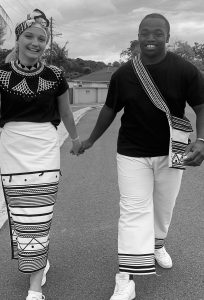
I’m 19 years old, and I have already seen things that have made me 1. shocked and 2. somewhat ashamed to be white. Not ashamed of my identity, but ashamed of how privilege has fought my battles for me, while others had to fight alone. My privilege might protect me from the worst of it, but it also gives me the responsibility to notice it, to call it out and to speak up.
Once, I was walking through a government hospital to fetch a file. As I approached the queue, I was stopped by a security guard who offered me a sticker that said “priority.” Just because of the colour of my skin. The message was clear: I could skip the queue, even though others had been waiting for hours. No questions asked. It was a big fat no. I refused the sticker and sat on the same hard and uncomfortable bench as everyone else. Why should I get to cut the line? My time is not more valuable than anyone else who was there. My life is not more important. What shocked me most was that these stickers even existed – meaning people actually use them.
Another moment still sits uncomfortably with me. I was pulled over by the police and the officer greeted me and asked, “Are you fine?” At the time, I thought it was a strange way of asking how I was. Being oblivious to it all, I smiled and said I was fine and asked him how he was doing. As we drove off, I spoke up about my confusion and my boyfriend and friends laughed and asked, “do you not notice”. The officer was checking if I was “fine” because, in his eyes, a young white girl in a car with three black people might be in trouble. As South Africans we have learnt to laugh about these things. But the truth is, there’s a much deeper issue that’s been rooted into our country’s systems.
My relationship continues to be filtered through other people’s prejudices. We’ve learned to pretend we don’t notice the stares, the nudges or hear the whispers – but we do. At a rugby game, my boyfriend had to show a security guard his phone wallpaper – a photo of us together – just to prove that the tickets I had bought for my family actually included him too. On social media, we’ve faced comments questioning why our “paths have intertwined”.
It shouldn’t be this hard. And yet, for too many people, acceptance is still difficult. Difficult to allow, difficult to understand and difficult to acknowledge. But the truth is simple: we are all the same.
These are everyday reminders that our country’s racial divisions are still very much alive in people’s decisions, gestures and opportunities. Some people say, “But things are better now.” And yes, they are. But “better” does not mean “good enough.” Real change means confronting the ways that privilege and prejudice still shape our everyday lives. It means refusing the “priority” sticker. It means questioning why an officer assumes your friends are a danger to you. And it means not letting stares dictate how you live.
We cannot get comfortable with a half-healed wound. If we want a South Africa that truly belongs to all who live in it, we must do the uncomfortable work of speaking up and pulling up the roots of racism that still run deeply beneath our democracy. Until then, apartheid will remain alive, not in the law, but in our everyday lives.